
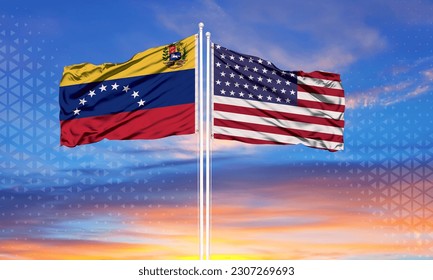
Aftermath of US strike on Venezuela
By Godwin Peter
It was more or less the 8 wanders of the World when On 3 January 2026, the United States military conducted a major operation in Caracas, Venezuela, involving air strikes and special forces that resulted in the commando capture of President Nicolás Maduro and his wife Cilia Flores.
The U.S. transported them to New York to face federal criminal charges, including narcoterrorism and drug trafficking.
The operation, titled “Operation Absolute Resolve,” included strikes on strategic locations across northern Venezuela.
In the ensuing development,Delcy Rodríguez, Venezuela’s vice president, was sworn in as ag. president under the Venezuelan constitution after Maduro’s forceful removal.
The U.S. President Donald Trump publicly stated that the U.S. would “run” Venezuela until a transition could be established, effectively suggesting a strong governance influence
The political Implications of the attack on International Law and Sovereignty are severe and deep.
Major international opinion holds that what the U.S. did violates international law, especially the UN Charter’s provisions on sovereignty and non-use of force without Security Council authorization.
At the UN Security Council, both U.S. allies and adversaries criticized the operation. Many countries including China, Russia, and several Latin American states described it as a crime of aggression.
Latin American countries are deeply divided: some condemning the move as infringement on sovereignty, others (notably right-wing leaders) celebrated the removal of Maduro.
The operation inflames U.S. tensions with global powers like Russia and China, who have longstanding strategic relationships with Venezuela.
The US attack may encourage other major powers to justify unilateral action, thus weakening multi-lateral conflict resolution systems.
Venezuela has the world’s largest proven oil reserves. The U.S. intention to liberalize or increase oil production could shift oil markets, affect prices, and reshape energy alliances.
In Nigerian ,political voices are already interpreting the event as a message about legitimacy. For example, the African Democratic Congress (ADC) said the capture sends a strong message to governments lacking legitimacy and criticized President Tinubu’s silence.
ECOWAS and African Union statements, aligning with broader African concerns, emphasize sovereignty and peaceful processes over unilateral interventions.
Oil and Economic Impacts
If U.S. oversight leads to increased Venezuelan oil output, this could put downward pressure on global oil prices. Nigeria highly dependent on oil revenue for its 2026 budget might face reduced revenue, forcing expenditure cuts or economic adjustments.
On International Law and Foreign Policy,
Nigerian analysts warned that the operation undermines the UN Charter, raising concerns about what it means for smaller states. If powerful countries can use force without broad international backing, Nigeria and other African states argue that it could damage global norms on independence and territorial integrity.
Regional Security Considerations
Nigeria, as a leading power in ECOWAS, may be drawn into broader discussions about regional responses to foreign interventions and how to uphold international law. The situation could influence Nigeria’s diplomatic priorities in multilateral forums.
The U.S. capture of Venezuela’s president represents a dramatic escalation in foreign intervention and has already triggered:
Global legal and diplomatic debate on sovereignty and the use of force.
Political debate in Nigeria, highlighting concerns about legitimacy, sovereignty, and international norms.
This event may reshape global geopolitics in 2026 and beyond, with particular sharp impacts on how powerful nations exercise influence and how smaller states respond to such actions.My guess could be as good as yours,Russia on Ukraine and China on Taiwan.